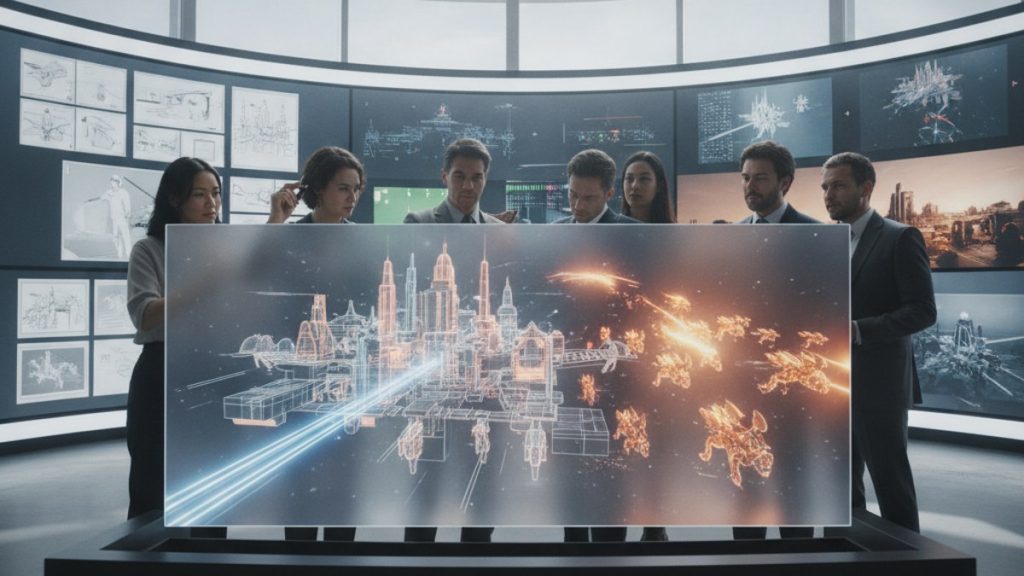
The Invisible Magic: How Visual Effects Shape Current Blockbusters
Behind the most spectacular scenes of the movies we love, there is a team of artists and advanced technologies that turn the impossible into visually stunning reality.
Announcements
In the entertainment world, especially in film and big-budget series, visual effects (VFX) have gone from being mere adornments to becoming the backbone of epic narratives and immersive experiences. From spaceships crossing distant galaxies to fantastical creatures inhabiting imaginary worlds, the ability to bring to life what was once inconceivable is what defines much of the blockbusters that dominate the box office and streaming platforms today.
But what is the true scope of this “magia” on screen?It's not just about adding explosions or digital monsters; it's a complex and intricate process involving cutting-edge art, science and technology, employed from the initial conception of a project to its completion. It's a meticulous work that seeks credibility in every pixel, allowing the audience to suspend disbelief and fully immerse themselves in the stories.
From Conceptualization to Post-production: The Workflow of VFX
The visual effects creation process is a multifaceted journey that begins long before the cameras even begin recording.It all comes from the preview (pre-visualization or “previz”), where directors and VFX teams collaborate to sketch complex scenes in a 3D environment. This allows you to test camera angles, character movements and the interaction of digital elements with the real environment, saving valuable time and resources during filming.
During production, elements such as motion capture (motion capture) and performance capture are crucial. Actors dressed in special costumes provide the basis for fully digital characters or to add realistic details to fantastic creatures.
Post-production is where most of the “magic”. Composition artists integrate filmed elements with digital assets (CGI), adjusting lighting, textures and colors to ensure a perfect fusion. 3D modeling, texturing, rigging, animation, particle simulation (fire, water, smoke), matte painting and particle effects are just some of the disciplines that intertwine to build each stunning scene.
Constant Innovation: Revolutionary Tools and Techniques
The VFX industry is constantly evolving, driven by technological advances that push the limits of what is possible. Software such as Maya, Houdini, Nuke, and Substance Painter are just the tip of the iceberg of a vast arsenal of tools. Rendering, which is the process of turning 3D models into photorealistic 2D images, has become faster and more sophisticated with GPU-based rendering engines and real-time ray tracing techniques that simulate the way light interacts with objects.
Artificial intelligence (AI) also begins to play a significant role, optimizing workflows, generating textures and even assisting in the animation of digital crowds.The creation of incredibly realistic” digital“duples, which can replace actors in risky scenes or even in entire sequences, is a testament to the level of detail and verisimilitude that can be achieved.
Another revolution is virtual production, where the use of large LED screens displays digital scenarios in real time on set, allowing actors and directors to see and interact with the final environment while filming. This not only improves the performance of actors, but also lighting and reflection on objects, integrating digital elements more organically.
The Future of Visual Effects: Beyond Imagination
What does the future of visual effects hold for us? The trend is towards even greater integration between the real and the digital, making the distinction virtually imperceptible.Virtual reality (VR) and augmented reality (AR), while still in specific niches, promise immersive experiences that can go beyond the screen, perhaps allowing viewers to “ent” into stories in new ways.
The growing demand for high-quality streaming content, coupled with competition for increasingly spectacular visuals, will continue to drive innovation.Sustainability also becomes a factor, with studios looking for ways to reduce the production carbon footprint, and VFXs can offer digital alternatives to scenarios and locations that would be logistically complex or environmentally impactful.
Ultimately, visual effects are more than just a technological display; they are an art form. Behind every breathtaking explosion, every fantastic creature or every alien landscape, there is a team of dedicated artists whose job is to translate a director's vision into a reality that captivates and inspires millions.