Coyote Vs. Acme's Critique Reaffirms Looney Tunes' Potential
Announcements
In the booming digital content market, where novelty seems to be the most valuable currency, the revitalization of icons of classic animation emerges as a complex challenge. The increasingly demanding public seeks not only nostalgia, but narratives that echo the values and humor of the modern era, without mischaracterizing the essence of what made them eternal. How to identify, then, the adaptations that really work and are not mere exercises of nostalgia?
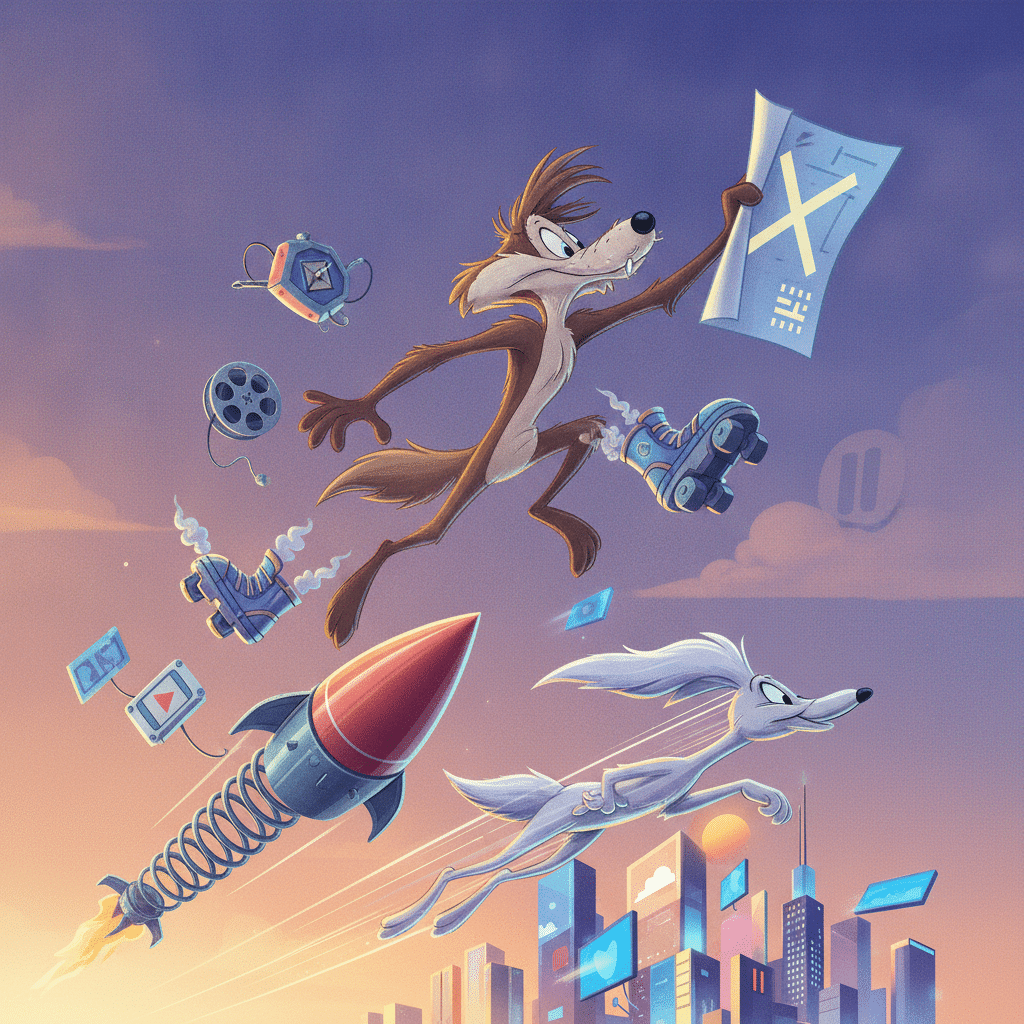
The recent production “Coyote Vs. Acme”, although still in a release limbo, has generated conversations that go beyond a film itself.It lights a beacon on the persistent relevance of Looney Tunes, suggesting that, yes, there is still plenty of space for Bugs Bunny, Pattolinus and Wile E. Coyote in the XXI century. This is not an article about the film, but about what it represents: a case study and a beacon for us to understand what makes a good adaptation and how the audience should approach these new investments in future properties to be explored and to be explored in the future universe we will find a guide the films that we will be navigated to be explored in this way.
The Anatomy of Humor Looney Tunes: Why It Still Resists
The Looney Tunes, born in the golden age of animation, have set a standard for physical comedy and narrative anarchy that few series have been able to replicate. Their appeal transcends generations and geographies for very specific reasons.
- The Slapstick High on Art: The Looney Tunes physical comedy is not free. It is built with millimeter precision, a balet of exaggerated actions and reactions that border on the surreal. The Acme machine, which always fails, the piano that falls on top of the character at the exact time, the hole painted on the wall that deceives the predator. Everything is part of a universal visual language that does not need complex dialogue to be understood or appreciated.
- Archetypal Characters and Universal Conflicts: The cunning Bugs against the irascible Bitch; the determined, but inept, Wile E. Coyote against the indomitable Scout-Pope; the piggy Pussy with his shyness.Each character represents an archetype with which the public connects, exploring themes such as persistence, frustration, cunning and the irony of fate. Their conflicts are simple, but their executions are infinitely creative.
- Breaking the Fourth Wall and Meta-Humor: The Looney Tunes were not afraid to acknowledge that they were cartoons. Characters who read the script, complain about the designer, or comment directly with the audience.This meta-humoristic approach was revolutionary and keeps fresh, allowing the series to play with its own conveniences and expectations.
- Impeccable Comedic Rhythm and Timing: Editing, soundtrack, and comic pauses are crucial elements to the effectiveness of Looney Tunes humor. They know when to speed up, when to slow down, and when to give the audience a moment to process the nonsense before the next gag.
When a new Looney Tunes production emerges, the first filter is to verify that it understands and honors these pillars.It is not about copying, but about channeling the same creative energy and intelligence behind the chaos.
Criteria for Identifying a Worthy Adaptation of Classics
The success of an intellectual property revitalization is not measured only by the noise it makes, but by its ability to integrate into the existing legacy without distorting it. For the attentive viewer, there is a set of criteria that can guide the evaluation of new series and films based on Looney Tunes or other classics of the animation.
1. Faithfulness to the Spirit, Not Just the Form
A good adaptation understands that the soul of the characters is more important than the exact replica of old scenarios or scripts.It means that Bugs Bunny must remain shrewd and undisturbed, irascible and selfish Bunny, and Wile E. Coyote an engineering genius with chronic bad luck. The fidelity here is philosophical, not literal.
- What to observe: Do characters act consistently with their established personalities?The new situations allow them to display their core qualities in fresh ways
- Common error: Changing the essence of a character to suit it for a more modern or politically correct narrative, resulting in something that does not sound authentic.
2. Narrative Innovation with Respect
No one wants to watch series of “great” hits or recycled gag compilations. A successful adaptation needs to find new ways to tell stories, explore different dynamics or even adopt unprecedented formats, as long as they serve the humor and essence of the characters.
- What to observe: Is the story original and interesting?It expands the Looney Tunes universe organically?The new approach adds value or just complicates what was simple and effective?
- Common error: Create an overly complex or dramatic plot that subverts the comic simplicity of the originals.The Looney Tunes was never about deep dramas, but about the next joke.
3. Timeless Humor vs. Dated References
Looney Tunes humor resists time because it is grounded in physical comedy, the subversion of expectations, and the interaction between archetypal characters.A new production should lean toward this type of humor, rather than relying too heavily on references to current pop culture that will quickly become obsolete.
- What to observe: Are jokes based on situations, personalities, and physicality or do they rely on memes, internet trends, or inside jokes that few will understand in a few years?
- Common error: Fill the script with references to superhero movies, social media or fashion sergas in an attempt to look like “atual” but failing to create something with longevity.
4. Quality of the Comedy Service Animation
Whether in traditional 2D animation, 3D or hybrid, visual quality should be impeccable and serve the comedy. The movements should be fluid, the expressions exaggerated and the visual timing accurate. Modern technology can improve, but should not dominate the expressiveness and classic style.
- What to observe: Is the animation expressive and dynamic?It contributes to the comedical timing of jokes?The character designs are true to their classic look, but with a modern twist?
- Common error: Excessively realistic animation or “limpa” that loses the elasticity and exaggeration characteristic of classic animation, or, on the other hand, a low-quality animation that compromises visual storytelling.
The Risks and Traps in Revitalizing Classical IPs
The path to success in revitalizing beloved intellectual properties is fraught with challenges. Many attempts fail, becoming examples of what not to do. Understanding these stumbles is essential so that the public can discern the good from the bad adaptations.
The Trap of Empty Nostalgia
One of the biggest temptations is to rely exclusively on public nostalgia. Films and series that only recycle old jokes, make innumerable references to the past without adding anything new, or that are limited to reassemble iconic moments, rarely resonate beyond an already captive audience.
- The danger: Create a product that is merely a “greatest” hits, without soul or narrative purpose of its own. This can alienate new generations and leave the old fans with the feeling that the essence has been lost in favor of repetition.
Dilute the Essence of Characters
In an effort to modernize, some creators may make the mistake of drastically altering the personalities of the characters. Transforming an antihero into a moralistic hero, or a cheater into someone too kind, and mischaracterizing what made them interesting in the first place.
- The danger: The charm of Looney Tunes lies, in part, in their imperfections and in their sometimes selfish or malicious behavior, always with a touch of humor.The excessive” “correction can lead to characters without grace.
Underestimating the Intelligence of Current Public
The belief that modern audiences need more streamlined humor, didactic messaging, or a slower pace is a common mistake.Children today are exposed to a variety of sophisticated content and appreciate intelligence and rhythm in animation.
- The danger: Produce content that seems too infantilized or didactic, losing the sharpness and irreverence that have always been characteristic of Looney Tunes.
Too Many Messages and Too Little Divergence
While it is valuable to have positive messages in children's series, Looney Tunes were never fundamentally about moral lessons.They were about the sheer joy of comedy, subversion, and anarchy. An over-focus on educational or social messages to the detriment of fun and humor can be detrimental.
- The danger: Transform the series into a vehicle for teachings, reducing the element of escape and pure entertainment that is its trademark.
Frequently Asked Questions About the Future of Classical Animation
For the reader looking to navigate the growing volume of classic series adaptations and revitalizations, some doubts are recurring.
How can I tell if a new Looney Tunes series or movie is worth it?
Note whether the production maintains the rhythm and timing of the comic characteristics, whether the characters act according to their essential personalities (Smart Bugs, selfish Bitch, cute but cunning Tweety), and whether the humor is more physical and situational than dependent on fast cultural references.If the animation looks like a history lesson or an advertising tool, it may not be the best option for seeking balance between reverence and originality.
What role does nostalgia versus innovation play in these new products?
Nostalgia serves as a gateway, attracting old fans and generating curiosity. However, it does not sustain a long-term series.Innovation is crucial to keep the audience engaged, attract new generations and justify the existence of the new work. A good adaptation uses nostalgia as a basis, but builds something new and exciting about it, offering fresh experiences without betraying what came before.
Can Looney Tunes be “politically correct” without losing their grace?
The concept of “politically correct” is complex and varies over time. The essence of Looney Tunes humor lies in exaggerated physical comedy and subversion, not prejudice or malice. Adjusting certain jokes or representations that today would be considered insensitive is possible without compromising grace. The challenge is to do it intelligently, keeping the spirit irreverent and focus on the comedy of the absurd, rather than simply removing elements out of fear. Creativity in finding new ways to make laugh is the key.
What to expect from streaming platforms in relation to these classics?
Streaming platforms play a crucial role. On the one hand, they can be kept from the historical collection, offering easy access to the original episodes, educating new generations about what really is a classic. On the other hand, they are the main financiers of new productions. The public should expect that platforms invest in creators who understand the complexity and intrinsic value of these IPs, prioritizing quality and fidelity to the original spirit instead of just exploiting the brand name to generate clicks. The abundance of content also means that there will be both hits and mistakes.
The Undeniable Value of Physical Comedy and Narrative Anarchy
In a scenario dominated by complex narratives and intricate fictional worlds, the simple and straightforward appeal of physical comedy and Looney Tunes anarchy is more valuable than ever. They remind us that the diversion needs no justification. There is no need for heavy moral messages or character arcs of redemption; sometimes, all we want is to see an intelligent rabbit fool an impatient cacador, or a persistent coyote fail spectacularly in its pitfalls.
This kind of humor is universal, as it touches on basic human experiences: frustration with technology, the joy of simple victory, the pain of falling comica. And the meta-humor, which breaks the fourth wall, still resonates with an audience accustomed to constant interaction and memes. It validates the viewer's experience in a unique way, as if the animation knew it is animation and wanted to share the joke.
Conclusion: The Way Forward for Looney Tunes (and Public)
The “Coyote Vs. Acme” case is an eloquent reminder that the perpetuity of the Looney Tunes is not just a matter of nostalgia, but of a comedy model that still has a lot to offer. For these and other classic intellectual properties to thrive, both creators and the public need to adopt a discerning approach.
For creators, the challenge is to honor the past without holding on to it, innovating with respect and deeply understanding the essence of their characters and their humor. For the public, the recommendation is to be critical: to seek adaptations that present a delicate balance between fidelity to the original spirit and the courage to explore new narrative and visual territories. Do not settle for empty imitations. The true magic of Looney Tunes lies in their ability to make us laugh with the brilliant simplicity of chaos, and this, fortunately, has no expiration date.