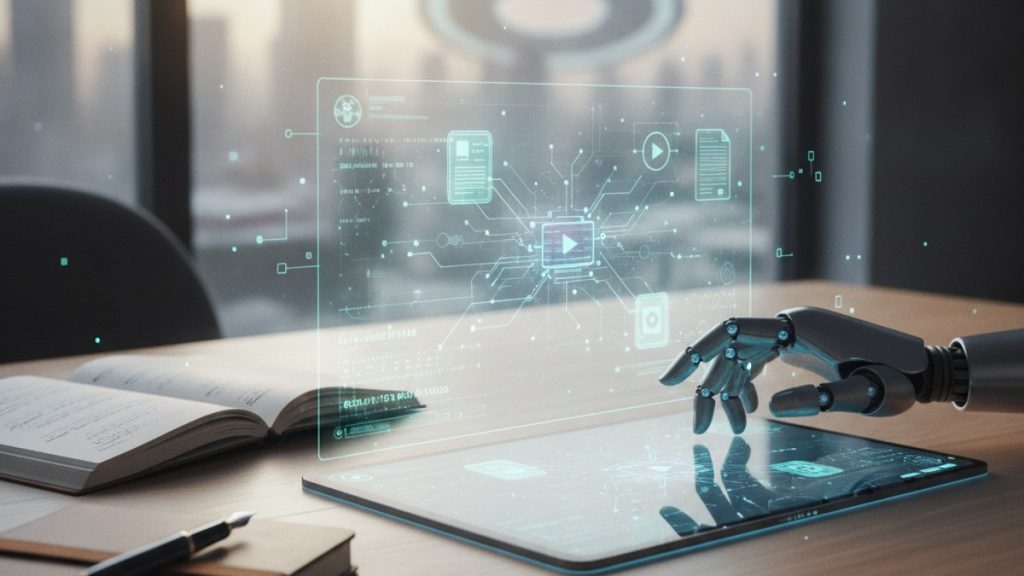
Artificial Intelligence in Cinema: Future or Threat for Screenwriters?
The rise of artificial intelligence in the creative cinematic process raises crucial questions about its role as an innovative tool or potential substitute for human screenwriters.
Announcements
Artificial intelligence (AI) has gone from being a science fiction concept to becoming a palpable reality in many industries, and cinema is no exception. In recent years, we have witnessed significant advances in the ability of AIs to generate text, images and even video sequences, raising a fundamental question for one of the pillars of film production: what will be the impact of AI on screenwriters? Would it be a revolutionary tool capable of optimizing and inspiring, or an existential threat to human creativity and jobs in the industry?
The Creative Potential of AI as an Auxiliary Tool
For many, AI emerges as a powerful ally in the creative process. Imagine a screenwriter who needs ideas for scenarios, dialogues or character developments. AI tools can analyze vast databases of scripts, identify patterns, trends and even suggest plot twists. This does not mean that AI “ will write the script alone, but that it can act as a tireless “instorming partner, offering starting points, exploring different directions for a scene or optimizing the structure of an act, always under the curatorship and direction of a human screenwriter. The ability to generate wide alternative time frames, to predict secondary productions could be the scale and to predict the audience.
The Current Challenges and Limitations of AI in Writing
Despite the potential, it is crucial to recognize that AI is still far from replicating the depth of human experience. Genuine creativity, that which arises from intuition, emotion, personal experiences and the ability to make unexpected and meaningful connections, is something that machines still do not master. A script is not just a logical sequence of events; it is a work of art that reflects the human soul. AI can simulate emotions, but does not feel them. Can it build coherent narratives, but the originality that breaks patterns and the ability to emerge or emote viscerally are still domains of the human being. There is also the issue of the personality of a material that has a writer's personality, how does it exist, each one that defines a writer's content that is a writer's.
The Threat of Substitution or the Age of Collaboration?
The fear that AI can replace screenwriters is understandable and echoes similar concerns in other industries. Recent strikes in Hollywood have brought to light the agenda of regulating the use of AI, demonstrating that concern is not unfounded. However, the prevailing view among experts is that AI will establish itself more as a tool of aid than as a complete substitute. The work of the screenwriter goes far beyond the mere generation of text; it involves the conception of original ideas, collaboration with directors and producers, the adaptation to feedback and the injection of a true human perspective that no machine can replicate. AI can generate thousands of words per minute, but the desired ability to discern the character with the impact of which is to discern the desired, which is to discern the character.
Regulation and the Future of Shared Creation
For the integration of AI in cinema to be beneficial and fair, it is essential that there is a continuous dialogue and the creation of regulatory frameworks. Issues such as the attribution of credits, financial compensation for writers whose works were used to train AIs, and transparency about the use of AI in the production of a script need to be urgently addressed. The most likely future is not the extinction of the screenwriter, but rather the evolution of the profession to a role that includes the curatorship and the creative direction of AI tools. Screenwriters of the future may need to be “maestros of algorithms, using them to refine their visions, but always being able to focus the soul on the imagination and always be a tool that touches the imagination.
Ultimately, artificial intelligence in film is neither inherently a threat nor a lifeline; it is a new technology with immense potential. Its impact will depend on how society, industry, and crucially, screenwriters themselves will choose to integrate it. If viewed as a collaborator rather than a competitor, and if the safeguards necessary to protect human creativity and the rights of professionals are established, AI could indeed open up new and exciting avenues for the art of storytelling on the big and small screen.