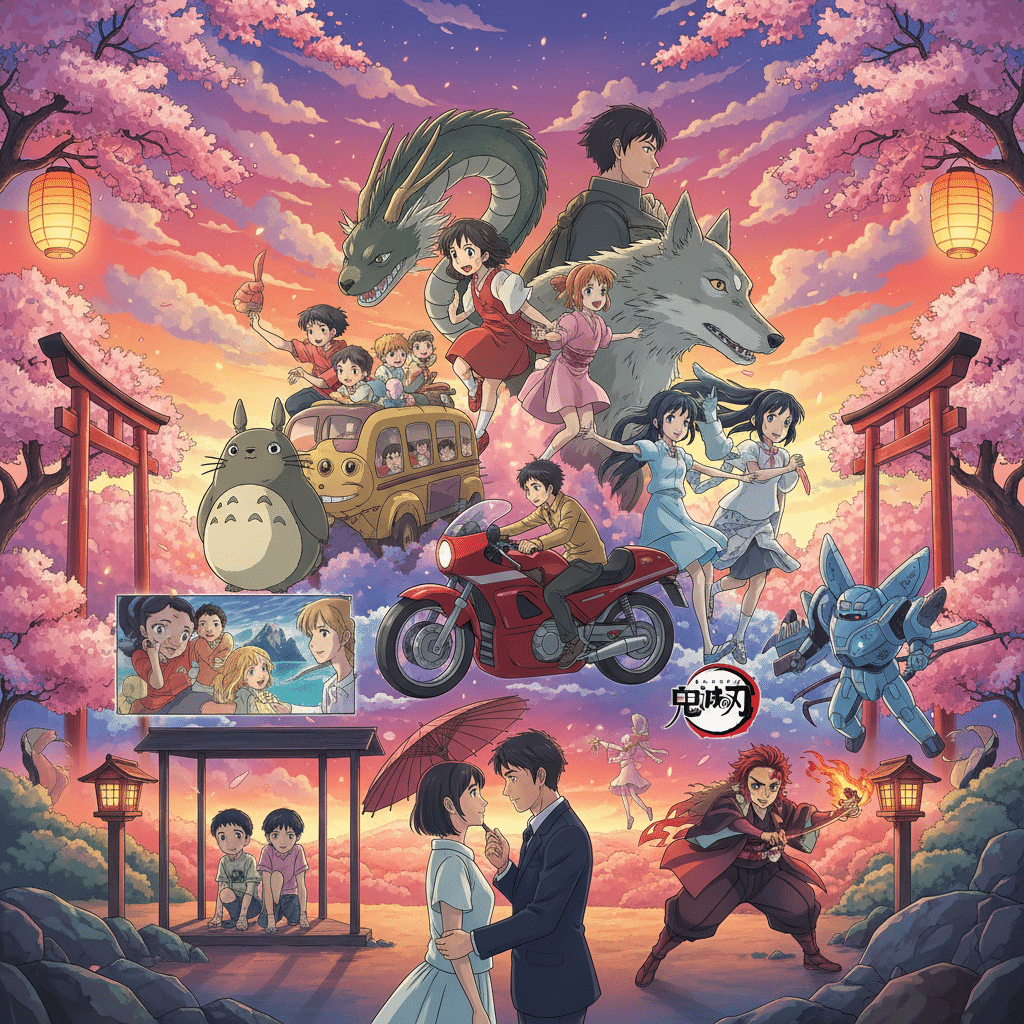
Importance and legacy of Japanese anime
Japanese anime is a artistic medium that has transcended borders, captivating audiences with deep and emotional stories. It is a cultural expression that combines tradition and modernity.
His films represent the legacy of a genre capable of addressing complex themes from fantasy to drama, showing the creative richness of contemporary Japanese cinema.
Anime as an artistic and cultural medium
Anime is a unique form of visual and narrative communication that goes beyond children's entertainment. Explore emotions and values that resonate with audiences of all ages.
Through anime, Japan shares its culture, history and philosophy, using animation as a cultural bridge connecting viewers from around the world.
Films such as à el voyage de Chihiro armen and Îr. Princess Mononoke armen stand out for their deep messages and exquisite aesthetics, consolidating anime as art.
Main directors and studios
Hayao Miyazaki is a world reference whose work has defined the image of modern anime with his mythical and poetic vision. His films are indispensable classics.
Other directors such as Katsuhiro Otomo and Mamoru Oshii have set trends with innovative works such as igueraAkira armen and igGhost in the Shell, armen that broke the mold.
Studios like Studio Ghibli and Kyoto Animation have fueled the diversity of anime, offering everything from epic fantasy to social sensibility and contemporary realism.
Studio Ghibli classic movies
Studio Ghibli is a cornerstone of anime thanks to its films that combine fantasy, emotional depth and universal values. His works have marked generations.
With a unique visual style and immersive narratives, Ghibli takes the viewer into magical worlds that explore the relationship between humans and nature, war and childhood.
Spirited Away
àSpirited Away is a milestone that redefines anime as art. The story follows a girl who must rescue her parents in a spiritual world full of trials and learning.
Hayao Miyazaki's masterful direction combines elements of Japanese culture with messages about maturity and identity, making this film an indispensable classic.
Its international success and prestigious awards reflect anime's ability to excite and teach, positioning it as a global masterpiece.
Princess Mononoke
Îprincess Mononoke presents a feudal Japan where the conflict between humans and nature manifests itself with intensity. The film challenges the children's genre with complex themes.
The complexity of its characters and the ecological philosophy it transmits make it a profound epic that invites us to reflect on environmental balance and coexistence.
It is considered a fundamental work to understand the narrative maturity of anime, showing the strength of Studio Ghibli in adult plots.
The Moving Castle
This film takes the viewer to a fantasy steampunk world where war and appearance intertwine with adventure. The characters are complex and emotionally rich.
Hayao Miyazaki addresses topics such as self-acceptance and the destructive nature of conflict, offering a story that mixes visual beauty with thematic depth.
The Moving Castle continues Ghibli's tradition of exploring human problems through anime, establishing itself as a memorable work.
The tomb of the fireflies
Directed by Isao Takahata, this film is a moving tale of the horrors of war from a children's perspective. It is a classic that breaks with Ghibli's traditional fantasy.
Its realistic and emotional approach shows the tragedy of World War II and the fight for survival, awakening empathy and deep reflection in adult audiences.
The Grave of the Fireflies has become a symbol of anime as a serious means of telling shocking and universal stories.
Fundamental works outside Ghibli
In addition to Studio Ghibli, there are films that have deeply marked anime, exploring diverse genres and styles. These works are essential to understanding the evolution of anime.
This section highlights titles that revolutionized Japanese animation, addressing mature themes and innovative techniques that influenced later generations.
Akira and its impact on gender
Akira is an iconic film directed by Katsuhiro Otomo in 1988, which shocked the world with its dystopian narrative and detailed animation. It revolutionized the anime genre.
The story of Neo-Tokyo and the secret military project combines science fiction with social criticism, setting a new standard for Japanese animation and its thematic maturity.
Akira remains instrumental in understanding how anime can address complex themes such as power, youth, and urban chaos in profound and visually striking ways.
Ghost in the Shell and science fiction
“Ghost in the Shell”, directed by Mamoru Oshii in 1995, is a pioneering work in science fiction within anime, dealing with identity and artificial intelligence in a cybernetic future.
Its influence extends beyond anime, inspiring international films and series, and showing the medium's ability to raise complex philosophical questions.
The film stands out for its atmospheric atmosphere and advanced visuals that combine action and reflection, consolidating it as an essential classic of the genre.
Neon Genesis Evangelion: The End of Evangelion
This film is the cinematic conclusion to the influential 1990s series, offering an intense and symbolic closing that marked anime fans.
“The End of Evangelion” delves into psychological, existential and apocalyptic themes, delivering a story full of complex emotions and deep symbolism.
Its innovative visual style and challenging narrative make it an essential title for those seeking an anime that transcends the traditional conventions of the genre.
Featured contemporary animes
Contemporary anime continues to evolve, bringing visual and narrative innovations that connect with new generations. Great directors explore universal and current themes.
Recent films show the power of anime to tell deep, emotional stories, mixing fantasy, romance, and social issues relevant to modern audiences.
Your Name and Time with You by Makoto Shinkai
Makoto Shinkai has become a benchmark for contemporary anime with films that combine visual impact and emotionality. ÎEYour Name armband surprised with its originality and sensitivity.
ăYour Name arsen tells a story of destiny and connection between two young people, with impressive urban and rural settings that capture the beauty of Japan and human complexity.
àEl tiempo contigo arse continues in this line, exploring everyday life and the ephemeral nature of time, with a poetic approach that mixes realism and supernatural elements.
A silent voice and its social sensitivity
àA silent voice stands out for addressing delicate topics such as bullying and disability with great respect and emotional depth, marking an important point in the anime's narrative.
This film invites reflection on empathy, second chances and the importance of communication, differentiating itself for its honest and humane social approach.
Produced by Kyoto Animation, it strikes a balance between visual beauty and sensitive treatment of personal conflicts, connecting with viewers who value authentic stories.